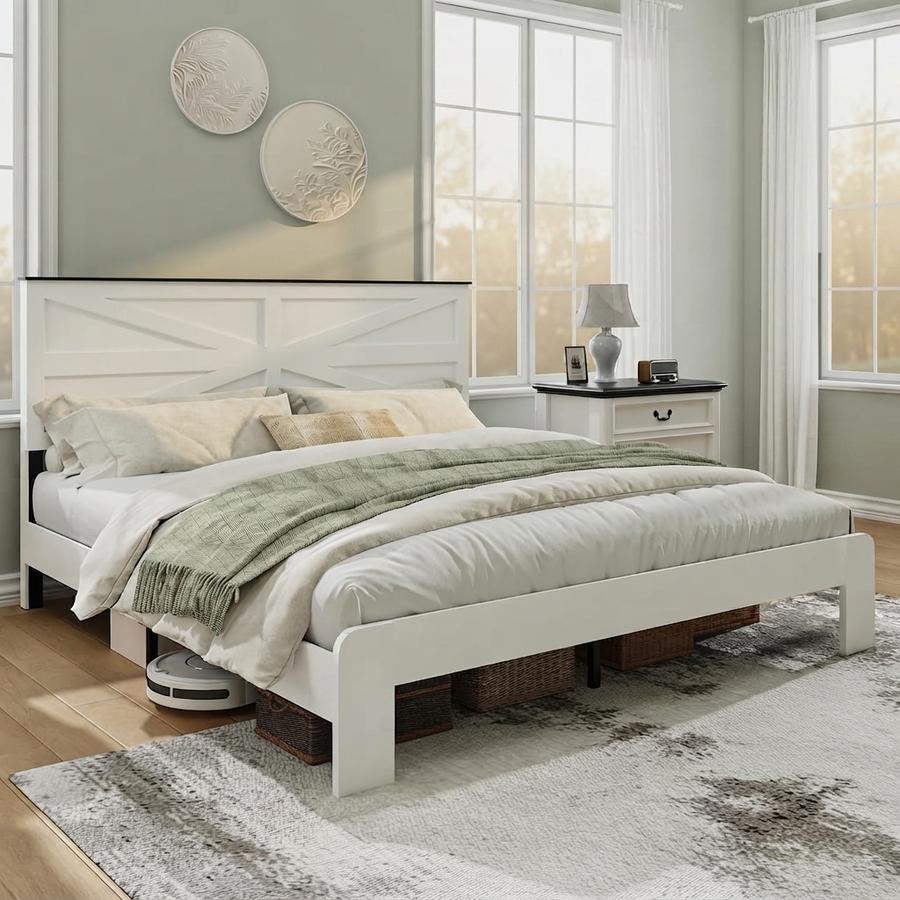
01
Roll Over at 3 a.m. Without the Creak
Sound-dampening foam sits under every slat seat, so a midnight turn stops short of the tick your old metal frame made.
Farmhouse platform beds
PAUKIN platform beds replace the frame that creaks by winter: 1,000 lbs on padded slats, no box spring, and 4.1★ across 722 verified reviews.

PAUKIN buyers swap a ticking metal base for padded slat seats: roll over at 3 a.m. and the frame stays quiet.
Sound-dampening foam sits under every slat seat, so a midnight turn stops short of the tick your old metal frame made.
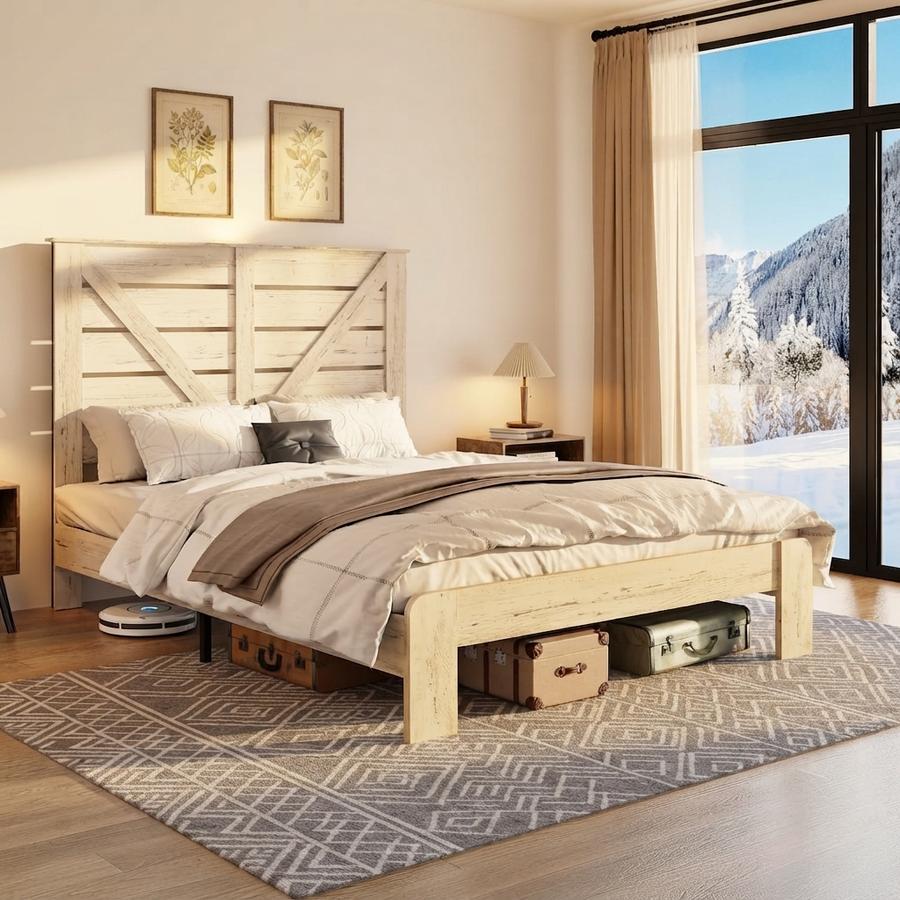
Drop a memory-foam, latex, or spring mattress straight onto the slats the night the box lands. Press a palm at mid-span two years on and the slat bank still sits flat, no box spring underneath.

Two adults, a 90-pound king mattress, and a dog land under half the 800-pound floor rating, and the slat bank still sits flat after a year of nightly sleep.

Plug a phone and a reading lamp into the headboard's own outlets before lights out on the charging models, and the extension cord under the rug goes back in a drawer.

Send the robot vacuum under the frame on its Tuesday schedule. Slide a storage bin into the same gap on the taller models, which clear 6.3 to 14 inches from floor to rail.

Bolt the frame together after work, sleep on it for three weeks, and ship it back inside the retailer's 30-day return window if the footprint crowds your door.
Full, Queen, and King platform frames carry the slat rating published per model, plus the gold bar cart that shares the same brand.
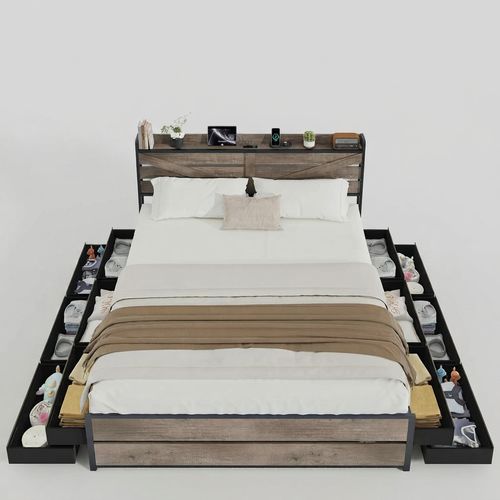
Twelve foldable drawers pull out from under the King for off-season bedding in October, then fold flat against the floor in June and hand the clearance back. Plug a phone into the headboard's outlets, USB, or Type-C port and set a book and an alarm clock on the shelf at arm's reach. Metal slats ride on safety clips with sound-dampening padding at each contact point, carrying 800 pounds without the knock a loose slat makes at 3 a.m. Where a fixed-drawer storage bed locks the space into its own boxes, this one converts back to open floor in an afternoon. The oak-finish King lands as a single 133-pound box, and the retailer's 30-day return window covers the two-person carry that box demands.
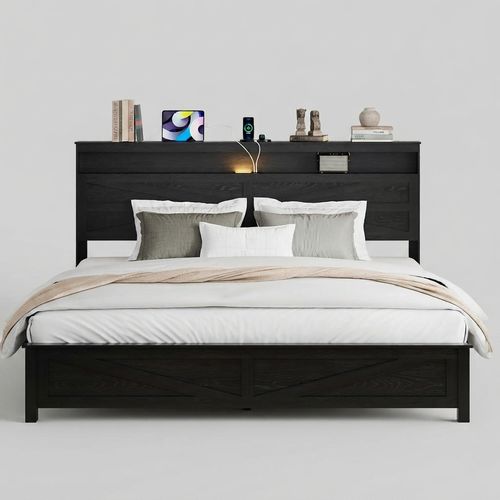
Read in bed without a lamp on the nightstand: the LED strip built into the headboard doubles as bedside light, and the charging station takes a USB or Type-C cable at the same panel. A metal base under wooden panels carries up to 1,000 pounds, with sound-absorbing foam where slat meets rail killing the friction that ticks at 3 a.m. Under a reading lamp at night the black finish reads industrial rather than farmhouse-soft, which is why it lands in rooms with dark bedding and metal fixtures. Where a separate lamp and power strip eat the whole nightstand top, this King folds both into the headboard before the first night. Every component ships in one box with instructions, and you can ship the frame back inside the retailer's 30-day return window.
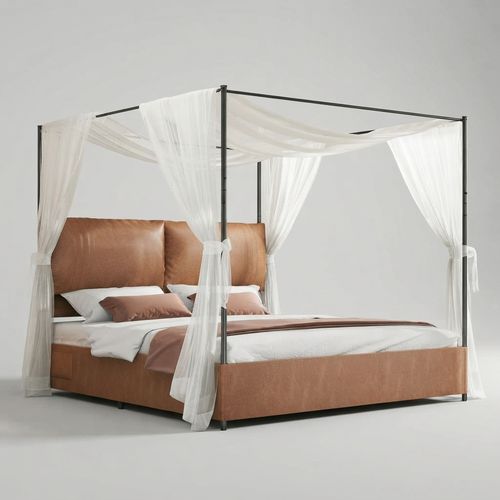
Lean back against two removable faux-leather cushions instead of a hard headboard rail, then lift them off when the room wants clean metal lines again. Twelve slats rest on EVA sponge and quiet buckles, the joint that rubs and ticks on a bare metal canopy inside a few months. String lights across the top rails for a birthday and hang bed curtains the same evening: the four-poster structure carries them alongside a rated 1,000 pounds of mattress and sleepers. Where an upholstered platform bed traps dust in a sewn-on panel, these cushions come off for a wash. Numbered accessories assemble inside an evening, and the retailer's 30-day return window covers the fit check.
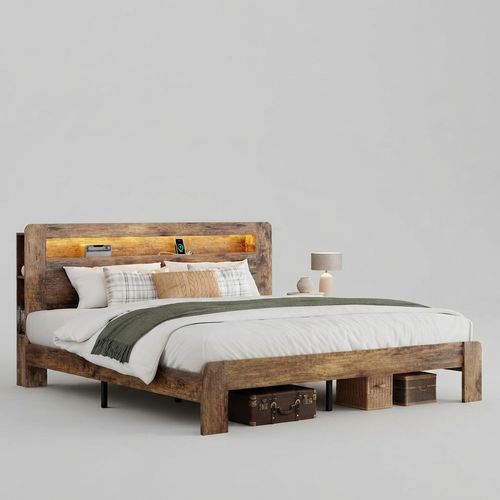
Plug a phone into the headboard at midnight and leave the socket behind the dresser alone. Two outlets and a USB port sit at pillow height under a soft LED strip: charge the phone and read from the same panel. Drop a paperback and the alarm clock into the headboard compartments and the nightstand goes out of the room. Roll toward the wall at 3 a.m. and the foam at each slat contact point holds a King mattress and two sleepers quiet. Send a robot vacuum under the rail on its Tuesday run: clearance runs 8.3 inches from floor to rail. Pre-drilled numbered parts put one adult through assembly in about an hour, and the retailer's 30-day return window covers the fit check.
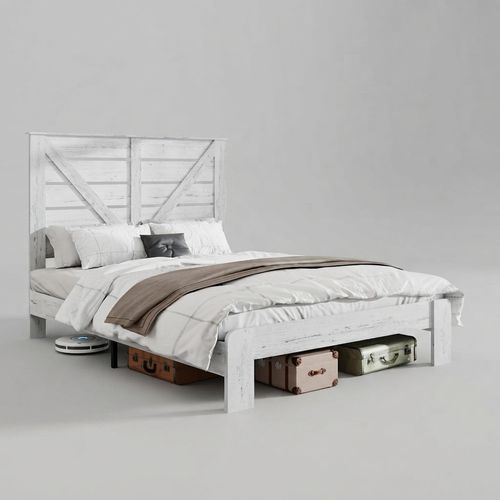
A Full frame rated to 1,000 pounds is unusual at this size, and that headroom is what keeps the slats flat under a heavy foam mattress past year two. Lay the mattress on extra-wide wooden slats over reinforced steel: nothing slips at the rail and no box spring goes underneath. Lean against the open horizontal-bar headboard with a book at 11 p.m. and it stands high enough to read against without a pillow wedged behind you. Slide the bins that used to sit on the closet floor into the gap under the frame. Hardware and instructions ship inside the box, and one adult finishes the build in an evening.
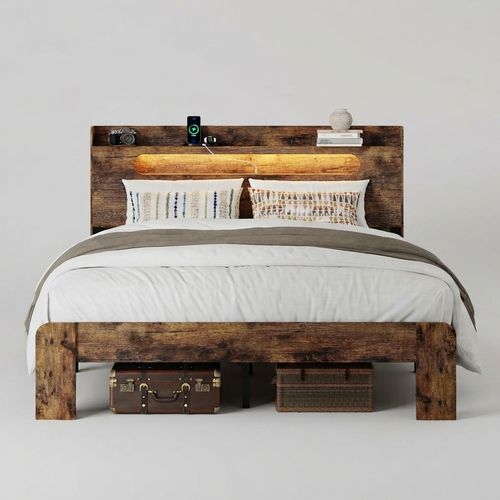
Plug a phone and a reading lamp in at the headboard of a Full bedroom with no floor left for a nightstand: two standard outlets, a Type-C port, and a USB port sit inside the panel under a remote-controlled LED strip. Books and an alarm clock drop into the headboard compartments instead of stacking on the floor. Clearance runs 6.3 inches, which sends a robot vacuum through on its Tuesday run but stops a tall storage bin, so measure before you count on both. Roll over at 3 a.m. and the silent foam strips where wooden slats meet the metal base hold the 800-pound platform quiet. Numbered parts finish the build in one evening, and the retailer's 30-day return window covers the fit check.
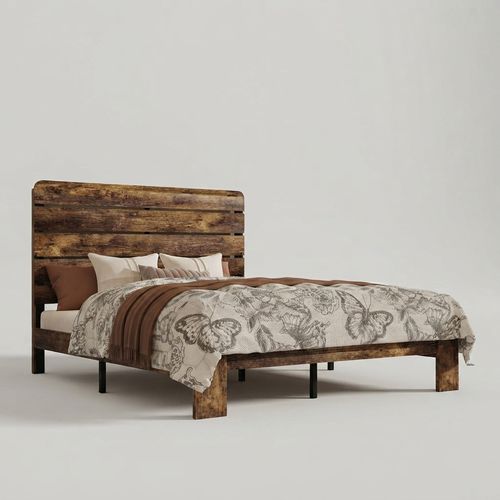
Slide storage bins into 8.2 inches of clearance under the Queen and still run a vacuum head along the same gap. Sleep on extra-wide wooden slats over a 1,000-pound reinforced metal structure and your weight lands across the span, not on the center rail. The open slatted headboard leans back far enough to read against without a pillow wedged behind your shoulders. Where a solid panel headboard blocks a low bedroom window at sunrise, this open design lets the light through. Every component and the instructions ship together, and one adult finishes the frame inside an hour.

Slide a storage bin and a vacuum head under the Queen: four posts rise from a gold matte frame on a 14-inch platform. Drop a latex, memory-foam, or spring mattress straight onto steel slats spaced 5.9 inches apart, with 800 rated pounds spread across the span. At 60 pounds the frame is the lightest carry here, which you notice on the second flight of a walk-up. Where a wooden canopy needs two people and a mallet, this one goes together with a friend in a single evening from one box. This model alone states a worry-free 30-day warranty, and 217 verified buyers hold it at 4.1 stars months into ownership.
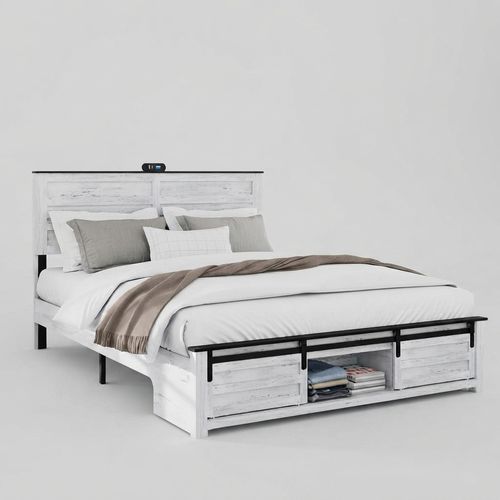
Push sheets and a spare blanket into the footboard behind a sliding barn door on exposed metal rails, and storage stops eating the floor beside the bed. That same wood body sits on a metal base rated to 800 pounds, with heavy slats spreading the load so the Queen stays quiet through a year of nightly sleep. Plug a phone into the headboard's built-in outlets and dim the LED strip from the remote without getting up. Boho white with barn-door hardware keeps a farmhouse room bright where a dark stain would close it in by winter. Unpack one box of numbered parts on the bedroom floor, and ship the frame back inside the retailer's 30-day window if the footprint fights the room.
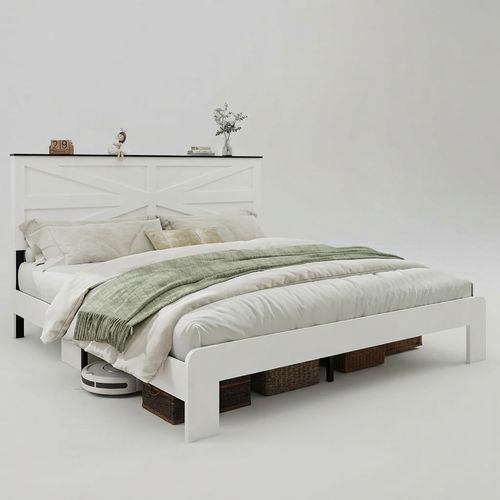
Stack a memory-foam King on the plug-in slat system and the geometric headboard still sits flush to the wall: reinforced metal support legs and wood panels carry a rated 1,000 pounds. Heavy wooden slats spread weight across the span instead of loading the center rail, which is where a budget frame starts to squeak in its first season. White wood grain holds a small bedroom bright through a grey January, and the geometric panel gives the wall more than a flat board. Where a metal platform makes you buy a bunkie board before the foam goes down, this one takes the mattress directly. Numbered parts and included tools finish the build in about an hour.
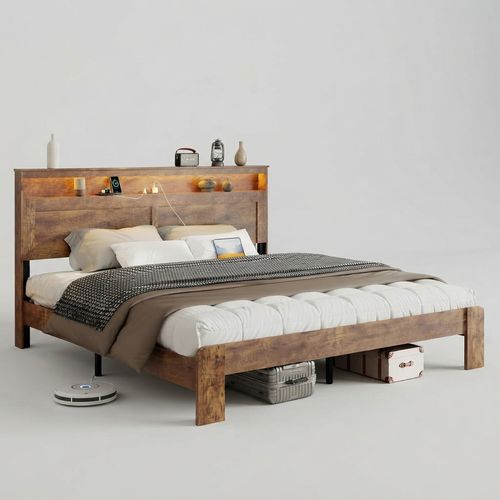
Set the headboard strip to a warm static tone for a chapter before sleep, or run a dynamic mode when the room needs colour, all from a remote you work from under the covers: 20 static modes and 22 dynamic ones. Built-in outlets and USB ports sit in the same headboard, so at 11 p.m. a phone and a lamp both stay off the floor. Wooden slats distribute weight across a metal structure rated to 1,000 pounds, which is what keeps a King quiet through a year of nightly sleep. Rustic brown wood grain with built-in shelving reads farmhouse in daylight and disappears into the dark after lights out. Numbered parts come out of one box and go together across a single evening on the bedroom floor.

Load bottles, a shaker, and a bucket of ice onto the top shelf, then roll the whole setup from kitchen to patio in one trip. Stack bottles, glassware, and a full ice bucket across four tiers: the iron frame carries up to 66 pounds. The faux-marble top wipes clean after a spill because the surface is sealed rather than porous stone. A rotating wine carousel turns the back bottle to the front without unloading the rack, and four locking casters hold the cart still on patio stone once the pour starts. Where a fixed serving console eats a corner year-round, this one parks in a closet between parties. Roll the cart out for a second summer of parties: 278 verified buyers hold it at 4.2 stars.
Measure your gap, count your plugs: PAUKIN publishes clearance in inches and outlet counts a buying guide leaves you guessing at.
| Measured | What it changes at home | What other pages leave out | Source |
|---|---|---|---|
| 2 outlets + USB + Type-C | Plug a phone, a reading lamp, and a monitor cable into the headboard panel at 11 p.m. without reaching behind the dresser for a socket. | Open three competing bed-frame pages tonight and you will compare mattress support and warranty terms, then still count plugs by squinting at a photo. | manufacturer spec |
| 20 static + 22 dynamic modes | Set the strip to a warm static tone for a chapter before sleep, then run a dynamic mode the night friends come over: 20 static and 22 dynamic modes on one remote. | Line two platform beds up at checkout and both pages say 'LED headboard', so you learn the mode count the night the box lands. | manufacturer spec |
| 12 slats, EVA-cushioned | Twelve slats rest on EVA sponge and quiet buckles on the canopy frame, so rolling over at 3 a.m. stops making the sound that used to wake the person beside you. | Owners ask whether 'squeak resistant' survives a first winter, then read a page that names the feature and never the part that damps the joint. | manufacturer spec |
| 6.3-14 in clearance | Push a robot vacuum under the lowest frame at 6.3 inches on its Tuesday run, or slide a storage bin beneath the 14-inch canopy model with room left above it. | Push a vacuum and a bin at the same gap and most product pages answer in adjectives like 'spacious', never in inches you can measure. | manufacturer spec, per-model clearance measurements |
| 4.1★ / 722 reviews | Read past the unboxing-week five-stars: the 4.1-star average still holds across 722 verified reviews written months into ownership. | Scroll an unbranded platform-bed page and you usually count a dozen ratings, not 722 that keep arriving months after delivery. | 722 verified buyer reviews |
| 12 foldable drawers | Pull twelve foldable drawers out for off-season bedding in October, then fold them flat in June and hand the under-bed floor back to suitcases. | Count drawers on any storage bed and you get the number. Walk that space back to open floor in June and only a fold-flat bank does it. | manufacturer spec |
Charging at the headboard, an 800-pound load path, twelve fold-flat drawers, and dimmable light: what each one changes at 11 p.m.
Plug a phone, a lamp, and a tablet in at pillow height: the charging-station headboard carries 2 AC outlets, a USB port, and a Type-C port. Run the cable inside the headboard shelf the night you build it, and the extension cord across the rug goes back in a drawer.
Two adults and a 90-pound king mattress settle onto the slat bank without the frame shifting an inch, because reinforced metal support legs carry the load path on the wood-panel models. A year of nightly sleep later, that pair still leaves better than half the rated 800 pounds unused, and the corner brackets sit where they were bolted.
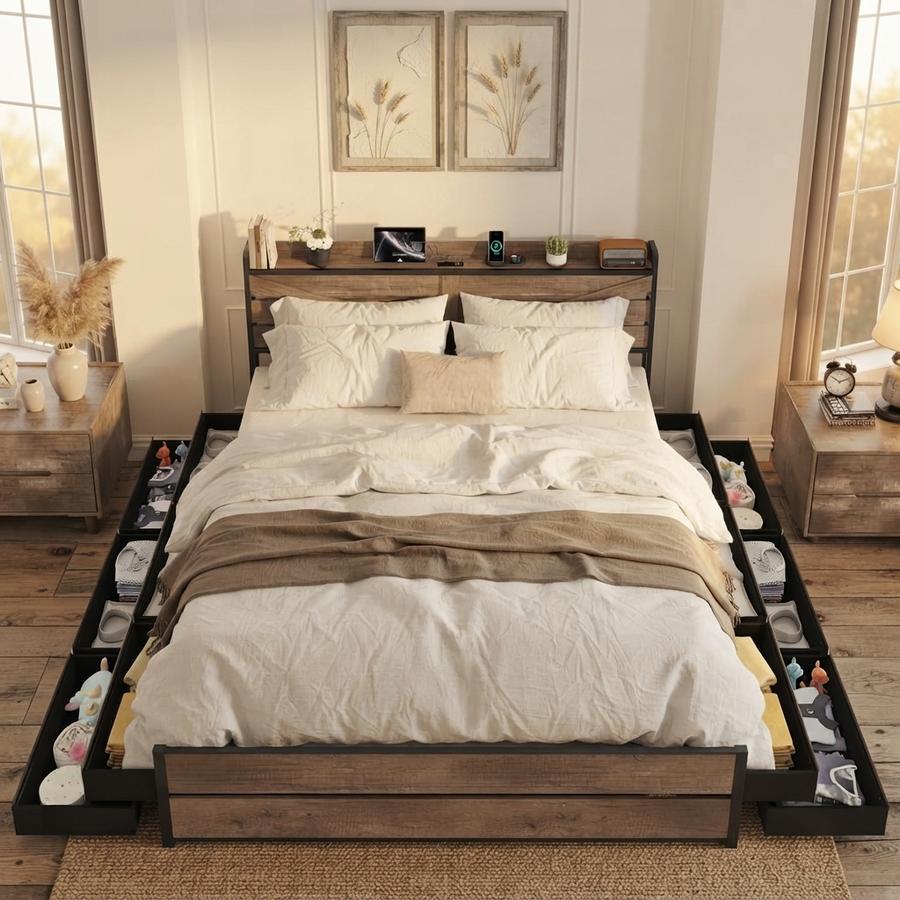
Pull one of 12 foldable drawers out from under the storage King in October and drop a winter duvet and a season of sweaters straight in. Fold them flat against the floor in June and the space under the bed opens back up for suitcases and a vacuum head.
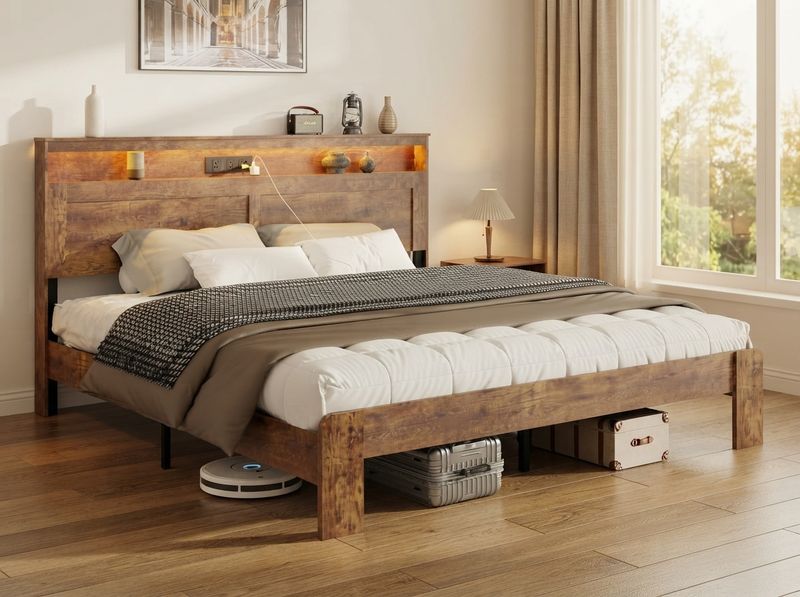
The LED strip built into the headboard runs 20 static light modes and 22 dynamic modes from a remote, dropping to a low amber glow for a 2 a.m. bathroom trip. Switch the strip off in the morning and it sinks back into the wood grain, so the bedroom reads farmhouse by daylight and not arcade.

Every budget bed frame prints 'noise free' on the product page you read, and 90 days later the joints tick on every turn. PAUKIN went after that tick before the wood tone, and you hear the difference on the first night's third turn. Push a hand against the corner post of a built frame and you feel the bolted metal bracket hold the rail where a wood-on-wood joint would already have worked loose, with foam seated at every slat contact point.
The proof sits in the review set rather than the sales copy: 722 verified buyers hold PAUKIN at 4.1 stars months into ownership. One renter swapped out a steel base that had started ticking inside three months, then slept a full year on the Queen canopy frame without hearing it once. Read the per-model ratings before you spend, though, because the storage-drawer King sits well below the canopy Queen with buyers and this page will not average that away. Farmhouse wood grain covers all of it in Full, Queen, and King, and your mattress goes straight on the slats the evening the box lands.
Read the full brand story →PAUKIN ships the frame flat in one box: lay out the numbered panels after work, bolt the base, and sleep on it that night.
Lay the pre-drilled panels across the bedroom floor and check every numbered part against the manual diagram before the first bolt goes in.
Attach the metal support legs to the side rails first, then seat each slat into its padded clip before the headboard goes on.
On the charging models, run the outlet lead through the panel while the headboard still lies flat on the floor, not after it meets the rails.
Drop the mattress straight onto the slats the same evening the box lands: no box spring, no bunkie board, no plywood sheet underneath.
Buyers write about night three, the ninety-day mark, and the drill they wish they had used on assembly night.
Assembly was pretty straightforward. The metal is very durable. Alignment is a bit tricky but just don’t tighten the screws too early and you should be fine. It requires two ppl to assemble but I managed to do it on my own in 1.5 hours. No squeaking at all. I love this bed!!
It took a while to assemble the two queen-sized beds (I’m a klutz!), but we are very pleased with the end result. I had a problem with one part, and a new one was sent out shortly after I reported it. It is a very good value for the money, and it definitely meets our need well.
Did I put it together perfectly? No. Did I do it by myself? Yes. Which I don’t recommend lol There were a lot of pieces and a couple of times I wanted to throw the screws across the room because I couldn’t find the hole on the other side but overall not bad to put together and it looks stunning.
The bed frame is nice and sturdy however the drawers are on the flimsy side, that said it sure holds a TON of stuff!!Took the better part of the day to put it together by myself although not to complicated. As usual with these the instruction could have been better but I've seen worse. Just take your time and pay close attention to the orientation of the different parts. Overall happy!!
Nice bed! Love how it looks! Beautiful color! Wasn’t too hard to assemble but would recommend having a second person to help. One of the long boards came pretty bowed but it went together just fine and in the end it wasn’t noticeable. Love the little light in the headboard. Overall a good value.
Easy assembly. It took my partner and I about 45 minutes to put it together. I am very happy with the sturdiness. My previous bed frame had the small metal slates that were constantly coming loose and undone. The wooden slates are velcroed down and spaced apart perfectly to hold up our king mattress with no caving in. The wood headboard looks so sleek and rustic. I can't wait to see how it holds up, but I am very happy with the quality of the frame for the cost. Definitely worth the purchase.
I LOVE my bed. It really is quiet, and sturdy.As a 5’2 woman I put this bed together myself. It definitely took me more than 6 hours, but it was worth it.Assembly absolutely requires 2 or more good builders.All pieces were together, and everything was in great condition. This bed is just as it was described. 10/10.It was supposed to be here 08/5/25, but I got it 08/1/25. AND the seller shipped it the day after I ordered it. Seriously, just buy it.
A nice affordable bed frame. Wasn't to difficult to assemble. Nice yourself about ab hour or 2 to put it together. Instructions were pretty straught forward. Its sturdy and also has a little light on the head board that plugs in via. USB. Overall happy with the product
Bolt the base on unboxing night, roll over silently in week one, and press the corner post 12 months on.
Lay the numbered panels on the bedroom floor after work and bolt the base together in about an hour. Walk the assembled frame past your bedroom door that same night, and ship it back inside the retailer's 30-day window if it crowds the doorway.
Roll toward the wall at 3 a.m. in the first week and hear nothing. Listen at the rail on night five: the foam under each slat seat has taken the friction the old frame ticked with.
Coil the extension cord from under the rug and drop it in a drawer by week four: on the charging models, phone and lamp draw power at pillow height.
Press a palm on the corner post twelve months in: the bracket still holds tight, and the slat bank still carries the mattress and both sleepers with no sag at the center.
Ready for Day 1? Pick your size and compare the slat ratings side by side.
Carry a PAUKIN frame into a thin-walled rental, a king-mattress bedroom, or a small room with no wall left for a dresser.
The landlord's steel frame has ticked since spring, and you want the replacement out in one carload when you move. A Queen frame breaks back down to numbered panels on moving day, and the padded slat seats keep the noise out of a thin-walled apartment.
Two adults drop a king memory-foam mattress straight onto the slats and land well inside the published rating a wire-slat base gives up on. Press down at the center after a year and the span still sits flat.
Stack the off-season sweaters in bins on the closet floor each winter, because the room has no wall left for a dresser. Load twelve foldable drawers under the storage King in October, or slide a standard bin into the gap on the open-clearance frames.
Friday drinks start in the kitchen at six and end on the patio by dark. Load the gold bar cart with bottles and an ice bucket, roll it out on locking casters, and its 66-pound capacity across four tiers holds the whole setup in one trip. The wine carousel turns a full circle, so the back bottle comes forward without unloading the rack.
Count the hardware bag, carry a 133-pound box up a stair turn, wait for the tick at month three.
Ninety days in, a budget frame starts ticking every time you turn toward the wall, and that is the complaint owners raise most in this category. Run a finger between slat and rail on most PAUKIN frames: foam and a quiet buckle sit where cheaper beds go bare metal on metal. Put a wrench on the corner bolts once at the ninety-day mark and the padding carries the rest of the year.
A King box lands at the curb weighing 94 to 133 pounds, and a narrow stairwell turns that into a two-person carry rather than a hand-truck job. Full and Queen boxes come in lighter at 60 to 90 pounds, which one adult can walk up a single flight in stages. Book the second set of hands for the day the box arrives, not for the evening you finally decide to build it.
Count the hardware kit against the manual diagram on the floor before the first bolt goes in, because a missing bracket discovered at step six costs the whole evening. Lay the numbered parts against the diagram and the audit takes five minutes on the bedroom floor. Message the seller through the product page for a replacement piece, and keep the shipping carton flat behind the door until the frame stands on its own legs.
Put an engineered-wood panel in a damp basement bedroom through August and the edges swell where solid hardwood would hold. Run a dehumidifier in a humid climate, keep the frame off a below-grade floor, and wipe a spill off the panel that night rather than letting it sit until morning. No third-party moisture rating is published for these panels, and this page will not invent one.
One frame here publishes a 30-day warranty, the Gold Metal Canopy Bed Frame in Queen, and it covers that model alone. Read the other product pages and you find no brand-wide warranty at all, which this page will not paper over. What covers every purchase is the retailer's 30-day return window: sleep on the frame for three weeks, push hard on the corner posts, and ship it back inside that window if anything moves.
Thirty-day returns run through the retailer on every frame here: pick a size and compare the slat ratings.
Box springs, slat spacing, doorway clearance and what the warranty actually covers, answered in the order buyers ask them.
A farmhouse-style platform bed frame built from engineered wood panels over a metal support structure, sold in Full, Queen, and King. The slat system carries the mattress directly, rated to 800 pounds on most models and 1,000 on several. Several models add a storage headboard with power outlets, and one swaps open under-bed space for twelve foldable drawers.
The slat bank does the work a box spring used to do, spreading weight across the frame and holding the load the published rating covers. Latex, memory foam, and innerspring mattresses all sit straight on the slats. Skipping the foundation keeps the bed at a normal height instead of stacking it near chest level, and it removes the one part that sags on its own schedule.
Full, Queen, and King only. A California King mattress overhangs a standard King frame by four inches and needs a different frame entirely. Full boxes carry lightest at roughly 84 to 87 pounds.
Engineered wood panels, usually MDF with a wood-grain finish, mounted on a reinforced metal frame with metal support legs. Slats are wood on most models and metal on the storage-drawer King. A pair of canopy designs step outside that pattern: a gold metal frame with steel slats, and an upholstered version with faux-leather cushions on the headboard.
A platform bed carries the mattress on a fixed slat bank instead of on a separate spring box that sags at its own pace. That removes one wearing part, drops the total bed height by six to nine inches, and opens usable floor underneath for storage. Foam mattresses in particular need the flat, evenly spaced support a platform gives, and most foam warranties require it.
Physically it fits, but the result sits high enough that climbing in feels like mounting a counter, and the box spring adds nothing structural on a slat bank already rated for the load. If you own a box spring and want the height, a low-profile version adds five inches instead of nine. Most owners skip it and use a thicker mattress instead.
Three trade-offs come up most. The bed sits lower, which sleepers with knee or hip trouble notice getting up in the morning, and a taller mattress recovers only some of that height. Under-bed clearance is fixed at whatever the frame publishes, from 6.3 inches to just over a foot, so a bin that slides under one model will not go under another, and swapping frames is the only fix once the bed is built. A very soft mattress also reads firmer on rigid slats than it did on a springy foundation, because the slat bank spreads weight instead of flexing under it. None of the three counts as a defect, but all three are permanent once the frame is standing.
Four specs decide it: published weight capacity, slat spacing under three inches for foam, a named noise-damping method at the slat-to-rail joint, and clearance in inches rather than a vague 'ample storage'. A frame that publishes all four is telling you it was measured. One that says only 'sturdy' and 'quiet' is asking you to take its word.
800 pounds on most models and 1,000 on several, counting mattress and sleepers together. Two adults at a combined 400 pounds plus a 90-pound King mattress use about 60 percent of the lower rating, which leaves headroom for a child climbing in or a dog at the foot. The rating covers evenly distributed weight, not a single point load like standing on the rail.
On the charging models, a panel inside the headboard holds two AC outlets plus a USB port and a Type-C port. A single lead runs from the panel to a wall socket, and that lead gets wired during assembly, before the headboard bolts to the side rails. From then on the wall socket behind the dresser stays free and cables stay at pillow height.
Standard cables work. The AC outlets accept any two-prong or three-prong plug, so your existing phone brick, a lamp, or a laptop charger all fit. The USB and Type-C ports take the cable that came with your phone. No proprietary connector is involved, and nothing needs to be bought separately to make the headboard useful on night one.
The lit models run 20 static light modes and 22 dynamic modes from an included remote, covering warm amber for reading, cooler white, and colour cycles. Brightness adjusts separately from colour. The strip mounts under the headboard lip rather than facing out, so light washes the wall instead of hitting your eyes when you sit up.
The remote kills the strip entirely, and the channel then sits recessed under the headboard lip where the wood grain hides it. Nothing glows in standby, so the frame reads as plain farmhouse wood.
Clearance runs from 6.3 inches on the lowest Full frame to just over a foot on the gold canopy Queen, with most models landing between eight and nine inches. The storage-drawer King replaces open clearance with twelve foldable drawers instead. Measure your storage bins before ordering: a robot vacuum needs about four inches, while a standard under-bed bin needs six or more.
Only one model publishes a number: the gold canopy Queen spaces its steel slats 5.9 inches apart. The rest describe extra-wide wood or metal slats without stating a gap, which is a real hole in the published specs. As a rule, memory foam needs spacing under three inches to avoid sagging between slats, so ask the seller before committing a foam mattress to an unpublished model.
King frames run 94 to 133 pounds boxed, Queens 85 to 120, Fulls around 84 to 87. Everything ships in one carton. The storage-drawer King is the heaviest carry and needs two people.
Twelve foldable drawers sit under the storage King. Each has fabric sides on a light frame, so it collapses flat against the floor when empty instead of staying a fixed box. Load them in October with off-season bedding, fold them down in June, and the under-bed floor comes back for suitcases. Product copy on that model also mentions thirteen drawers in one line, a source inconsistency worth confirming with the seller.
Foam, latex, and innerspring all sit directly on the slats with no foundation underneath. Foam benefits most from a platform, since even support stops the body impressions that form over a sagging box spring. Check slat spacing first on models that do not publish it: wide gaps under a soft foam mattress cause dips between slats within a year.
None of these models is published as adjustable-base compatible, and no product page states inside dimensions for dropping a base in. A rigid platform with fixed slats is generally the wrong host for an adjustable base, which needs either its own legs or a frame built as a surround. Treat these as fixed-height platform frames and plan an adjustable base separately.
The panels are engineered wood with a printed grain, not solid hardwood, and at arm's length that shows: the grain repeats and the edges are banded rather than milled. Reviews split on it, with the aggregate sitting at 4.1 stars and the strongest complaints naming finish feel rather than structure. If a genuine hardwood look matters more than the load rating, this is the trade-off to weigh.
One model publishes a warranty: the Gold Metal Canopy Bed Frame in Queen states a worry-free 30-day warranty on its own page. Nothing brand-wide is published for the rest, and no honest reading of the available material supports claiming one. That gap matters more than it sounds, because a frame warranty is what covers a cracked panel or a stripped bracket in month eight, and outside that one model the cover does not exist. What does apply to every purchase is the retailer's standard 30-day return window. Treat the first thirty days as the real test: build the frame, sleep on it, push hard on the corner posts, and decide inside the window rather than after it closes.
The retailer's standard 30-day return window applies to these frames like any other furniture purchase through the same channel. That covers the realistic failure cases: the footprint crowds the door, the clearance misses your storage bins, or the finish reads wrong against your bedding. Assemble promptly rather than leaving the box for three weeks, since the window runs from delivery, not from the day you decide to build.
Contact the seller through the product page, which routes to the brand's own support rather than a reseller chain. Count the hardware kit against the manual diagram before starting, since a missing bracket found at step six costs an evening. Keep the carton and packing inserts until the frame stands on its legs, because a replacement piece is far easier to arrange while the packaging still exists.
Third-party certification is not published for these panels, and none appears anywhere in the product material. That is a genuine gap rather than an oversight in the wording here. Buyers who need a certified low-emission or responsibly sourced frame should shop brands that publish the certificate number, since an uncertified engineered-wood panel cannot be verified after the fact.
Sleep trials belong to mattress brands and to premium frame makers selling direct, and this brand runs none. The retailer's 30-day return window is the equivalent protection. Assemble in the first week to leave decision room.
The 4.1-star figure is a weighted aggregate across 722 verified reviews, and the spread behind it is wide, with individual models ranging from 3.3 to 4.8 stars. Most of that weight comes from a pair of high-volume models at 278 and 217 reviews, so the headline number mostly describes those two. Several newer models sit under 20 reviews each, which is too thin to judge on its own, and one bad shipping week moves a rating like that by half a star. Read the reviews on the exact model you want, sort them to the most recent months, and weigh complaints about stripped screws and drawer material more heavily than unboxing-week praise.
Support runs through the seller contact on the product page, and the brand's own material commits to a reply within 24 hours on several models. That is thinner than a national furniture retailer with a service network. Weigh it accordingly: the 30-day return window is the reliable backstop, and support responsiveness matters most for the missing-bolt case rather than a five-year structural claim.
Every model sells online, and pricing moves often enough that any figure quoted here would be wrong within a week. Check today's price on the model you want, along with its current size and stock position.
Two structural differences show up in the specs. Weight capacity is published per model on the spec sheet, where budget metal frames often publish nothing. And the noise-damping method is named, foam pads and quiet buckles at the slat-to-rail joint, instead of the word 'quiet' with no mechanism behind it. Headboard outlets and under-bed drawers are the convenience layer on top.
Noise at the one-year mark comes from one place: fasteners backing out as wood panels settle and seasonal humidity moves them. Foam pads at the slat contact points remove the friction source that starts the tick, but they do not stop a bolt from loosening. Tighten every corner bolt at the ninety-day mark and again at a year, which takes ten minutes and prevents most of the noise complaints owners report.
New frames squeak because two rigid surfaces rub where a fastener has not fully seated, usually slat against rail or leg against bracket. Fix it in order: tighten every bolt in a cross pattern, seat each slat fully into its clip, then add felt or rubber between any two surfaces that still touch bare. Loose slats cause more noise complaints than the frame joints do.
One adult can complete the build in about an hour on most models, since parts arrive pre-drilled and numbered and no cutting or measuring is involved. The two-person moment is not the assembly, it is the carry: a King box at 94 to 133 pounds does not go up a narrow stairwell alone. Get the box to the room first, then work solo from there.
On the taller models, yes. A robot vacuum needs roughly four inches of clearance and a standard under-bed bin needs six. A frame at eight inches or more handles both, provided the bins sit clear of the vacuum's path. The lowest Full frame clears a vacuum but leaves too little for a tall bin. Measure your bins before choosing between models.
Flat panels and rails clear a 30-inch doorway in one box. Assembled is the problem: a King measures over 76 inches wide and will not turn a tight hallway corner. Build it in the room where it stays.
Platform frames suit renters well for two reasons. Nothing gets attached to a wall, so no patching at move-out, and the under-bed clearance replaces a dresser in a room without wall space. Weigh the carry: a Full or Queen frame breaks back down to numbered panels for the next move, while the heaviest King box is a harder repeat.
Bare metal legs mark hardwood once the bed shifts, and no floor pads ship with these models. Stick self-adhesive felt pads to each leg before the frame carries weight. On carpet, use rigid glides instead.
The headboard compartments sit above the mattress line, so they take no space from underneath. What they do take is room from the wall: a storage headboard adds four to six inches to the total footprint compared with a plain panel. In a room where the bed sits under a window, measure that depth before ordering.
A tall headboard works better in a small room than most people expect, because the vertical line draws the eye up and away from the floor. The open slatted and horizontal-bar designs help further, since light passes through instead of hitting a solid block. Avoid the tall solid panel if the bed sits under a low window, where it will cut the light.
A drawer bed needs pull-out room on the sides it uses, so centring it against one wall with two feet of walking space on each side works better than pushing it into a corner. Check which side the drawers open before assembly. On the fold-flat drawers here, collapsing the unused side is an option a fixed-drawer bed does not offer.
Metal wins on raw load and price, wood wins on noise and feel. A welded steel frame carries heavy loads without flexing, but bare metal joints rub against each other and start ticking once the bolts loosen, usually somewhere past the first six months. Wood and engineered-wood frames damp that vibration better, especially with foam seated at the slat contact points, though the panels swell in a humid room and strip at the screw hole after repeated disassembly. These frames run a hybrid: metal legs and structure underneath, wood panels and slats on top, which puts the load on the metal and the quiet on the padding.
Solid wood is milled lumber, so it sands, refinishes, and repairs, and it holds a screw thread through repeated assembly. Engineered wood is compressed fibre under a printed or laminated face: flatter, cheaper, heavier by volume, and it strips at the screw hole when a bolt gets over-torqued or the frame comes apart too many times. The practical difference shows up on moving day rather than in the bedroom, since a panel that survives one disassembly may not survive the third. These frames use engineered panels on a metal structure, which puts the structural load on the steel and leaves the panel spanning and skinning.
In a climate-controlled bedroom, an engineered-wood panel on a metal support structure holds up for years, because the metal carries the load and the panel mostly spans and skins. Two conditions shorten that. Standing moisture swells the fibre and lifts the laminated face, which is why a below-grade room with no dehumidifier is the wrong place for one. Repeated disassembly strips the screw holes, and a stripped hole does not come back: one move is fine, four moves in four years is where panels start to fail. Wipe spills the night they happen and the panel outlasts the mattress on it.
A premium solid-wood frame buys three things: real hardwood that can be refinished, joinery that goes together tool-free, and a multi-year warranty, typically at three to five times the outlay. This line trades all three for published load ratings, headboard outlets, and under-bed drawers at a fraction of that. The honest split is time horizon. If the frame has to survive four moves and a refinish in year ten, the hardwood earns its premium. If it has to hold a king mattress quiet in a rented bedroom for the next three years, the trade lands the other way.
A bunkie board is a fix for wide slat gaps, and it is unnecessary on a frame whose slats are already close enough for your mattress. Add one only if a foam mattress dips visibly between slats, or if the model does not publish slat spacing and you want insurance. It costs roughly two inches of height and blocks airflow under the mattress.
About an hour for one adult on most models, with pre-drilled numbered parts and included hardware. Charging models add ten minutes for the outlet lead, which wires before the headboard attaches.
Snug every bolt by hand in a cross pattern first, then torque them down once the whole frame stands square. Tightening one corner fully before the others pulls the frame out of square, and a racked frame squeaks no matter what padding sits at the joints. Seat each slat fully into its clip, and check that no slat floats a few millimetres above its rail.
One disassembly is routine: unbolt the rails, lift the slats out of their clips, and the panels travel flat. Repeated teardown is where engineered wood suffers, since screw holes widen a little each time and eventually stop holding torque. If you expect several moves, drive the bolts back into their original holes and consider threaded inserts for any hole that starts to spin.
Wipe spills off the face within minutes rather than letting liquid sit at a banded edge, which is where moisture gets into the fibre. Use a barely damp cloth and no soaking, no steam, and no ammonia cleaner on a printed grain. Keep the frame out of a damp basement room, and run a dehumidifier through humid months if the bedroom holds moisture.
Felt pads under each leg are a good idea on hardwood and add roughly an eighth of an inch. Raising the bed further with risers is riskier. A platform frame is engineered for load through legs sitting flat, and a riser concentrates that load on a small plastic cup. If you need more clearance, choose the taller canopy model rather than lifting a low one.
Frames photographed where they end up: a made bed against a bedroom wall, a cart parked by the patio door.
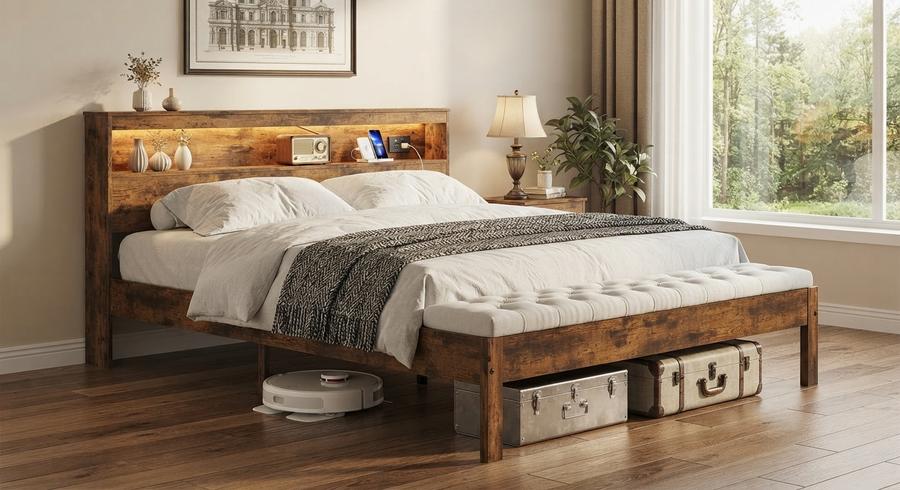



Amazon pricing updates daily
Check price